The Zinc Chemicals Market is expanding as chemical manufacturers, tire and rubber producers, agrochemical suppliers, and industrial coatings companies rely on zinc compounds to improve product durability, corrosion resistance, and crop nutrition. Growth is supported by expanding automotive and construction activity, micronutrient fertilizer adoption, high-purity pharmaceutical and personal care demand, and emerging energy-storage applications.
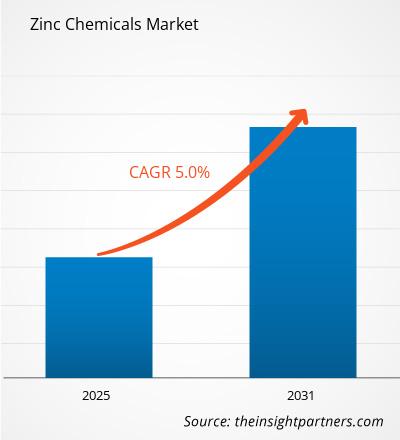
The Zinc Chemicals Market size is expected to reach US$ 14.16 Billion by 2031. The market is anticipated to register a CAGR of 4.8% during 2025-2031.
What is driving the market?
Industrial demand across rubber processing, protective coatings, and agricultural micronutrients represents the primary growth engine for zinc chemicals. Tire and rubber manufacturers depend on zinc oxide as an essential vulcanization activator and heat-dissipation agent, while construction and infrastructure developers rely on zinc-based primers and coatings to extend the service life of steel structures. Simultaneously, widespread soil zinc deficiency is accelerating the adoption of zinc sulfate and chelated zinc fertilizers to boost crop yields and food security.
The market is shifting toward higher-purity, specialty, and eco-friendly formulations rather than commodity-grade volumes alone. Producers are investing in nano-zinc oxide, low-heavy-metal pharmaceutical grades, and secondary zinc recovery processes. However, volatile LME zinc metal prices, energy-intensive production costs, and strict environmental regulations governing zinc runoff and emissions remain key constraints.
Which region leads?
Asia Pacific leads the market, accounting for an estimated 33%–45% share in 2025, and is also the fastest-growing region. Growth is supported by large-scale tire manufacturing, rapid urbanization, infrastructure construction, and government-backed micronutrient fertilizer programs. China and India represent major demand hubs as expanding automotive production and intensive farming coincide with domestic capacity additions in specialty zinc derivatives.
North America holds the second-largest share at approximately 28%–32%, driven by established coatings, rubber, and healthcare sectors alongside precision agriculture adoption. Europe accounts for roughly 22%–25%, supported by automotive manufacturing, strict industrial durability standards, and growing demand for medical- and cosmetic-grade zinc oxide.
Download Sample Report@ https://www.theinsightpartners.com/sample/TIPRE00005134
Which segment leads?
Zinc Oxide is the leading product segment, representing an estimated 55%–61% of market revenue in 2025. Its dominance is anchored by indispensable use in rubber vulcanization, ceramics, paints and coatings, and UV-filtering personal care formulations. Zinc Sulfate is identified as the fastest-growing product segment, propelled by rising global demand for soil micronutrient fertilizers and animal feed supplements.
By end-use industry, Rubber & Plastics and Construction/Coatings capture the largest share of consumption, reflecting high-volume industrial utilization in tires, polymer stabilizers, and anti-corrosive architectural finishes. Agriculture and Pharmaceuticals & Cosmetics represent high-growth end-use verticals as precision nutrient management and mineral-based skincare gain commercial traction.
Which companies are prominent?
Industry analyses identify EverZinc, U.S. Zinc, Zochem Inc., Zinc Nacional, American Zinc Recycling, Rubamin Pvt. Ltd., Weifang Longda Zinc Industry Co., Ltd., TIB Chemicals AG, Hindustan Zinc, and Nyrstar as prominent market participants.
These companies compete across French-process and American-process zinc oxide, agricultural-grade zinc sulfates, specialty zinc salts, and recycled zinc derivatives. Competitive differentiation increasingly depends on product purity, particle-size engineering, secondary feedstock integration, regulatory compliance, and reliable regional distribution.
What is changing in 2026?
In 2026, the market is moving toward stricter purity specifications, circular secondary sourcing, and cleaner manufacturing footprints. Buyers in pharmaceuticals, cosmetics, and electronics are increasingly specifying ultra-high-purity zinc oxide grades (above 99.5%) with tight trace-metal limits, while European Carbon Border Adjustment Mechanism (CBAM) pressures and sustainability mandates are accelerating secondary zinc recovery from industrial dust and scrap.
Manufacturers are also scaling eco-friendly synthesis routes, digital supply-chain traceability platforms, and battery-grade zinc chemical formulations. Procurement decisions are shifting from spot commodity purchasing toward qualified, specification-driven supplier partnerships backed by batch consistency and environmental certifications.
What are the major investment opportunities?
The strongest investment opportunities lie in secondary zinc recycling infrastructure, high-purity specialty grades, and battery-grade zinc electrolytes. Expanding hydrometallurgical and Waelz kiln recovery capacity allows producers to convert electric arc furnace dust and industrial residues into cost-competitive zinc oxide and zinc sulfate while lowering carbon intensity.
Additional opportunities include nano-structured zinc oxide for UV protection and antimicrobial coatings, slow-release chelated zinc fertilizers for micronutrient-deficient farmland, and high-purity zinc salts for emerging grid-scale zinc-ion and zinc-air battery systems. Asia Pacific and India offer compelling expansion potential due to rising domestic fertilizer consumption, tire manufacturing growth, and expanding pharmaceutical exports.
Get Full Copy of This Report @ https://www.theinsightpartners.com/buy/TIPRE00005134
Future Outlook
Over the 2025–2031 forecast horizon and beyond, the Zinc Chemicals Market is poised to transition from a traditional industrial commodity space into a higher-margin, specialty-driven value chain. While core demand from tire manufacturing and protective construction coatings will provide a resilient revenue floor, long-term outperformance will be shaped by three structural shifts: the commercialization of zinc-based stationary energy storage, wider adoption of bio-available zinc micronutrients to sustain global crop productivity, and circular production models that decouple chemical output from primary mining volatility.
About The Insight Partners
The Insight Partners is a leading market research and consulting firm delivering actionable insights through in-depth industry analysis and strategic intelligence. The firm supports clients across various industries in making informed decisions by providing comprehensive market forecasts, competitive assessments, and growth opportunities.
Contact Us:
If you have any queries about this report or if you would like further information, please contact us:
Contact Person: Ankit Mathur
E-mail: sales@theinsightpartners.com
Phone: +1-646-491-9876