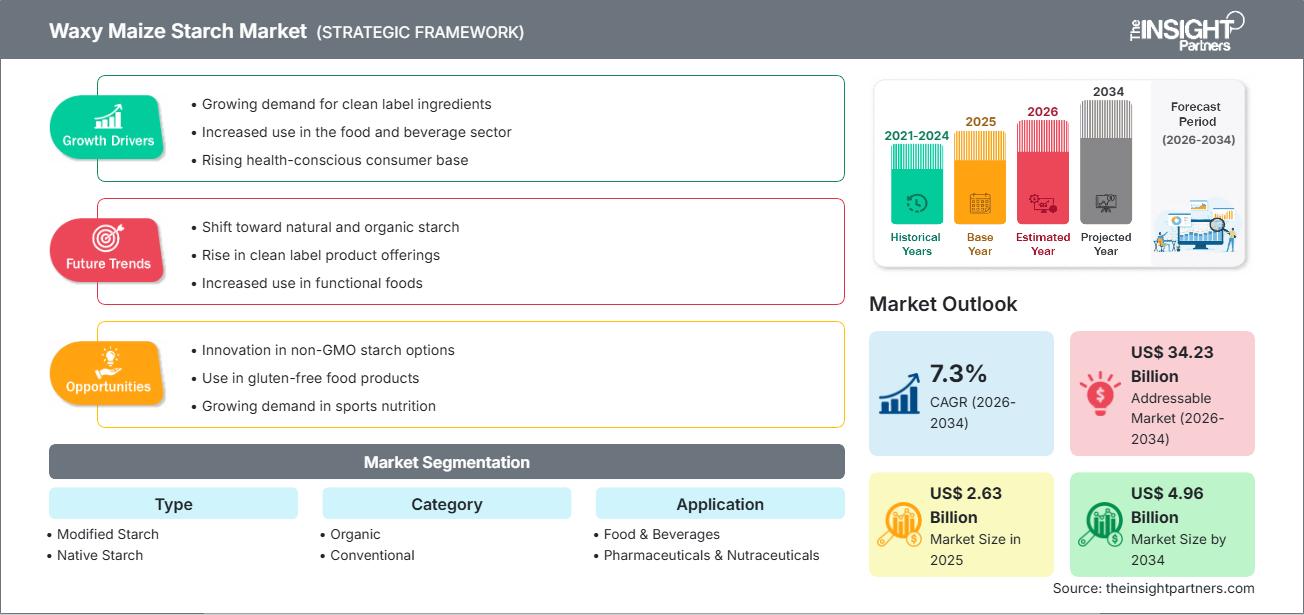
The Waxy Maize Starch Market is growing at a fast pace. It was valued at US$ 2.63 billion in 2025. It is expected to reach US$ 4.96 billion by 2034. That works out to a CAGR of 7.3% between 2026 and 2034. Waxy maize starch is made almost entirely of amylopectin. This gives it strong thickening power, clarity and stability. It is moving from a niche ingredient to a mainstream one.
What Is Driving the Market?
Clean-label demand is the first big driver. Shoppers read ingredient lists more closely than ever. They want fewer synthetic additives. Waxy maize starch, especially in native or physically modified form, gives food makers a natural way to build thickness and mouthfeel without chemical stabilizers.
Frozen and convenience foods are the second driver. Waxy maize starch keeps water from separating during freezing and thawing. That helps ready meals and frozen desserts keep their texture and shelf life. As demand for these foods rises, manufacturers lean on waxy maize to protect product quality.
Get exclusive insights into the Waxy Maize Starch Market – https://www.theinsightpartners.com/sample/TIPRE00029685
Better modification technology is the third driver. Enzymatic and physical methods now let producers build starches with exact traits, such as acid resistance and high-shear stability. These gains open the door to tougher industrial and culinary uses.
The market does face challenges. Corn prices can swing sharply. Farm yields are seasonal. Tapioca and potato starch also compete for the same customers.
Which Segment Leads?
By type, modified starch is the largest segment. These starches are engineered to survive tough processing, which makes them essential for high-acid sauces and long-shelf-life products. Native starch is growing quickly. The clean-label movement drives it, since makers want a natural image with strong thickening power.
By category, conventional starch is the main volume driver worldwide. It benefits from large-scale farming and cost-effective supply chains. Organic is a smaller but high-value niche. It is gaining ground in North America and Europe, where premium shoppers look for non-GMO and pesticide-free labels.
By application, food and beverages is the primary use. Pharmaceuticals and nutraceuticals is a high-growth segment. Here, the starch works as a tablet excipient and as a specialized carbohydrate in medical and sports nutrition.
Which Region Leads?
Asia Pacific is expected to be the fastest-growing region. Large production capacity in China and India, rapid urbanization and a booming food processing sector all support it.
North America holds a significant share. A strong corn-milling industry and advanced research capabilities support the region. The US is a key market, with a health-conscious consumer base and a sophisticated pharmaceutical sector.
Europe is a mature market with a strong focus on non-GMO and organic ingredients. South and Central America is an emerging hub, led by corn producers Brazil and Argentina. The Middle East and Africa has high potential as food processing and pharma investment grow.
Which Companies Are Prominent?
- Cargill, Incorporated
- Tate & Lyle PLC
- AGRANA Beteiligungs-AG
- Manildra Group
- Roquette Frères
- Sinofi Ingredients
- Tokai Denpun Co., Ltd.
- Sanwa Starch Co., Ltd.
- New Zealand Starch Limited
- SAMYANG CORPORATION
The field mixes large agribusiness groups with specialist starch refiners. Companies compete through specialization, wider portfolios and non-GMO supply chains.
Recent deals show the pace of change. In January 2026, Riddhi Siddhi Gluco Biols agreed to buy Cargill India's corn wet milling division. The deal helps it scale up derivatives, including waxy maize starch. AGRANA and Ingredion also won clearance in June 2025 for a joint venture in Romania. Ingredion took a 49% stake in the operating entity there.
Buy the Full Report https://www.theinsightpartners.com/buy/TIPRE00029685
What Is Changing in 2026?
Waxy maize starch is moving beyond food. It now supports paper, textile sizing, tablet binding and renewable adhesives. Regulation against single-use plastics is also drawing interest in starch-based packaging.
Shoppers are changing too. Plant-based and gluten-avoiding diets are more popular, and waxy maize fits both. Sports nutrition is another growth point. High-amylopectin starch offers sustained energy release, which suits athletes and clinical nutrition.
What Are the Investment Opportunities?
Sports and performance nutrition offers the first opening. Waxy maize can restore glycogen quickly without sharp insulin spikes. That makes it a strong fit for pre- and post-workout products.
Bioplastics is the second. Waxy maize is a renewable, biodegradable raw material. Investment in starch-based polymer research could unlock high-margin packaging products.
Emerging pharmaceutical markets are the third. As drug production scales up in India and Brazil, demand for high-purity starch will grow. It serves as a binder, diluent and disintegrant in tablets. With so many paths open, the market is well placed to keep growing through 2034.
Related Reading / Reports
Explore additional research from The Insight Partners covering related food ingredient markets:
- Food Additives Market — Covers ingredients that improve texture, taste and shelf life.
- Bakery Premixes Market — Looks at ready blends used by bakers and food makers.
- Marinades Market — Tracks sauces and flavor systems where starches add body.
- Milk Fat Fractions Market — Covers functional dairy ingredients for food manufacturing.
About US:
The Insight Partners is among the leading market research and consulting firms in the world. We take pride in delivering exclusive reports along with sophisticated strategic and tactical insights into the industry. Reports are generated through a combination of primary and secondary research, solely aimed at giving our clientele a knowledge-based insight into the market and domain. This is done to assist clients in making wiser business decisions. A holistic perspective in every study undertaken form an integral part of our research methodology and makes the report unique and reliable.
Contact US
If you have any queries about this report or if you would like further information, please contact us:
Phone: +1-646-491-9876
E-mail: sales@theinsightpartners.com
Also Available in : Korean | German | Japanese | French | Chinese | Italian | Spanish