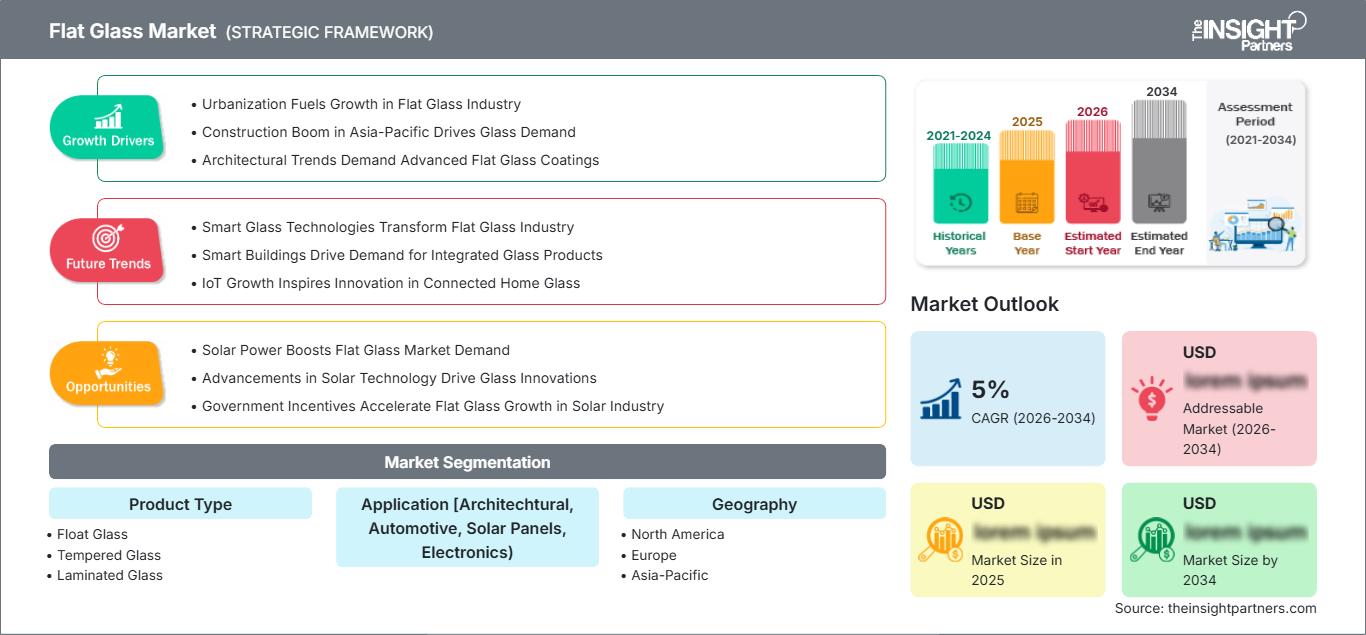
Construction activity is booming across emerging economies, and the push for energy-efficient buildings is reshaping material specifications worldwide. The Flat Glass Market is set to nearly double, growing from US$ 160.11 Billion in 2025 to US$ 323.18 Billion by 2034, at a striking CAGR of 8.12% during the forecast period 2026 to 2034. This is not simply volume-driven growth. It reflects a structural shift toward high-performance glazing solutions across architectural and automotive applications globally.
What Is Flat Glass?
Flat glass is a category of manufactured glass produced in sheet form through float, rolled, or drawn processes, forming the foundation for a wide range of value-added products. It encompasses basic float glass as well as processed variants including tempered, laminated, and insulated glass units, each engineered for specific safety, thermal, or acoustic performance requirements. Its applications span building facades, windows, automotive windscreens, solar panels, and display technologies.
Request a Sample Copy of the Report: https://www.theinsightpartners.com/sample/TIPRE00017578
What Is Driving the Flat Glass Market Forward?
The architectural sector is the single largest engine of flat glass demand, and the tailwinds here are considerable. Urbanisation across Asia-Pacific, the Middle East, and Africa is generating sustained demand for residential and commercial construction. At the same time, green building standards such as LEED and BREEAM are pushing architects and developers toward high-performance glazing systems that reduce solar heat gain, improve thermal insulation, and support passive energy design. Insulated glass units and low-emissivity coated glass products are seeing particularly strong specification rates as a result.
Energy efficiency regulation is accelerating this trend at the policy level. The European Union's Energy Performance of Buildings Directive is mandating near-zero-energy standards for new construction, effectively requiring advanced glazing in virtually every new build. Similar standards are emerging in North America, Japan, and South Korea. This regulatory pressure creates durable, non-cyclical demand for premium flat glass products that would not exist under purely market-driven conditions.
The automotive sector contributes a second major growth axis. Vehicle manufacturers are expanding glass surface areas in modern designs, incorporating panoramic roofs, large windscreens, and extensive side glazing that consumers now expect. Beyond aesthetics, laminated safety glass and acoustically dampened glass are becoming standard specifications rather than optional upgrades, particularly in electric vehicles where cabin refinement is a key differentiator. Advanced driver assistance systems also require precisely engineered windscreens with embedded sensors and heads-up display compatibility, increasing the technical complexity and value per unit of automotive flat glass.
Solar energy is emerging as a compelling third growth driver. Photovoltaic modules rely on ultra-clear, low-iron flat glass as a front sheet, and as solar installation targets scale globally, so does demand for specialist solar glass. This is a fast-growing sub-segment that did not register meaningfully in earlier market cycles but now represents a significant forward opportunity.
Segmentation Overview
The flat glass market is segmented by product and application.
By Product:
- Basic
- Tempered
- Laminated
- Insulated
- Others
By Application:
- Architectural
- Automotive
- Others
Tempered and laminated glass are the fastest-growing product segments, driven by safety regulations in both construction and automotive manufacturing. Insulated glass units are gaining rapidly in architectural applications as thermal performance requirements tighten. Basic float glass retains a large volume share in price-sensitive construction markets but is gradually being displaced by value-added variants in premium segments. Architectural applications dominate overall demand, accounting for the majority of global flat glass consumption by value.
Key Market Players
- AGC Inc.
- Cardinal Glass Industries, Inc.
- Saint-Gobain
- Schott AG
- Şişecam
- Almana Glass
- Dallas Flat Glass
- Cevital
- Guardian Industries Holdings
- Nippon Sheet Glass Co., Ltd.
The market is consolidated among a handful of global majors with integrated float glass operations, though regional producers play an important role in cost-sensitive construction markets. Technology investment in coatings, smart glass, and solar glass is increasingly a competitive differentiator among leading players.
Sustainability and Innovation Trends
Sustainability is becoming central to flat glass product strategy. Manufacturers are investing in electric and hydrogen-powered furnace technologies to reduce the carbon intensity of glass melting, one of the most energy-intensive industrial processes. Saint-Gobain and AGC have both announced decarbonisation roadmaps targeting significant emissions reductions before 2030, responding to customer pressure from construction and automotive clients with their own net-zero commitments.
Smart glass is the most commercially exciting innovation in the sector. Electrochromic and thermochromic glazing technologies allow glass to dynamically control light and heat transmission, reducing building energy loads without sacrificing natural light. Adoption is growing in commercial office buildings, luxury residential developments, and automotive sunroofs. Though currently a premium product, falling technology costs are broadening the addressable market with each product generation.
Buy Premium Report: https://www.theinsightpartners.com/buy/TIPRE00017578
Regional Outlook
Asia-Pacific dominates the global flat glass market, with China accounting for the majority of both production capacity and consumption. Rapid urbanisation, large-scale infrastructure investment, and a massive automotive manufacturing base combine to make this region the primary growth engine. Europe is a high-value market where stringent building energy regulations are driving premium glazing adoption at scale. North America benefits from sustained residential construction activity and strong automotive glass demand. South and Central America represent an emerging opportunity, with infrastructure development programmes and rising construction activity creating new demand pools across Brazil, Mexico, and the wider region.
Related Reports:
Anti-reflective Coatings Market
About The Insight Partners
The Insight Partners is among the leading market research and consulting firms in the world. We take pride in delivering exclusive reports along with sophisticated strategic and tactical insights into the industry. Reports are generated through a combination of primary and secondary research, solely aimed at giving our clientele a knowledge-based insight into the market and domain. This is done to assist clients in making wiser business decisions. A holistic perspective in every study undertaken forms an integral part of our research methodology and makes the report unique and reliable.
Contact Us:
If you have any queries about this report or if you would like further information, please contact us:
Phone: +1-646-491-9876
E-mail: sales@theinsightpartners.com
Also Available in: Korean | German | Japanese | French | Chinese | Italian | Spanish