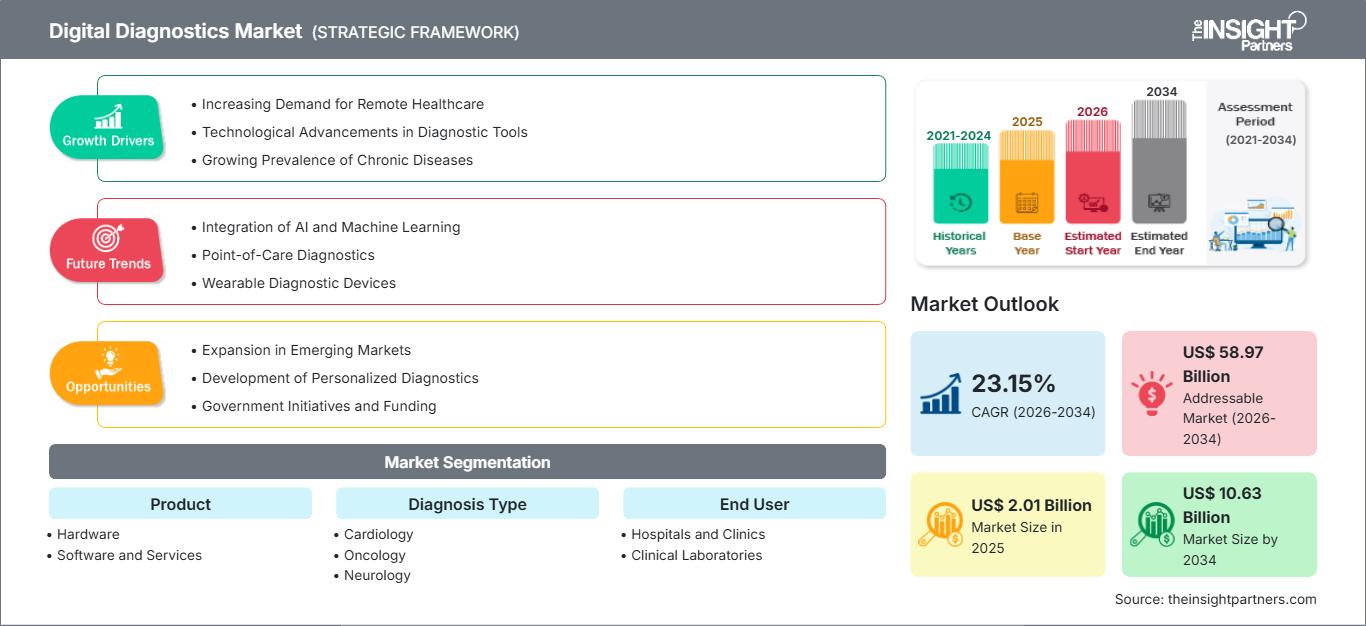
According to The Insight Partners, the global Digital Diagnostics Market was valued at US$2.01 billion in 2025 and is projected to reach US$10.63 billion by 2034, registering a compound annual growth rate (CAGR) of 20.33% during 2026-2034. Increasing adoption of artificial intelligence (AI) in healthcare, growing demand for faster and more accurate disease detection, rising investments in digital health infrastructure, and the integration of advanced software into clinical workflows are driving market expansion. Healthcare providers are increasingly adopting digital diagnostic platforms to improve clinical decision-making, streamline operations, and support personalized patient care.
Digital diagnostics refers to the use of digital technologies, connected devices, software platforms, and data analytics to support disease detection, screening, monitoring, and clinical assessment. These solutions include AI-powered imaging analysis, digital pathology platforms, diagnostic software, and connected healthcare systems. By integrating medical images, laboratory information, electronic health records, and clinical data, digital diagnostic technologies help healthcare professionals interpret findings and make informed decisions. Their applications span cardiology, oncology, neurology, radiology, and pathology.
Download Sample PDF - https://www.theinsightpartners.com/sample/TIPRE00040732
Digital Diagnostics Market: Key Players
Key companies operating in the digital diagnostics market include:
- Abbott Laboratories
- Roche Diagnostics International AG
- Siemens Healthineers AG
- Philips Healthcare
- Medtronic plc
- GE HealthCare Technologies Inc.
- Thermo Fisher Scientific Inc.
- Oracle Health
- Becton, Dickinson and Company
- Hologic, Inc.
Market Drivers and Emerging Trends
Increasing Adoption of Artificial Intelligence in Healthcare
The growing integration of AI and machine learning into diagnostic workflows is a major driver of the digital diagnostics market. AI-powered systems can analyze medical images, identify suspicious patterns, prioritize cases, and support clinical interpretation. These capabilities are particularly relevant in radiology and pathology, where healthcare professionals manage large volumes of diagnostic data. AI-assisted tools can help improve workflow efficiency and support more consistent assessments when used under appropriate clinical oversight.
Growing Demand for Early and Accurate Disease Detection
Early diagnosis is essential for improving treatment outcomes across conditions such as cancer, cardiovascular diseases, and neurological disorders. Digital diagnostic platforms support the analysis of clinical information and medical images, helping healthcare professionals identify potential abnormalities and make timely decisions. Increasing awareness of preventive healthcare and personalized medicine is encouraging healthcare organizations to invest in advanced diagnostic technologies.
Expansion of Digital Pathology and Imaging Solutions
Digital pathology and advanced imaging technologies are transforming traditional diagnostic practices. Whole-slide imaging allows pathology slides to be digitized, stored, reviewed, and shared across locations. These capabilities support remote consultations, collaborative diagnosis, research, and AI-assisted image analysis. Similarly, digital radiology platforms enable efficient image management and interpretation across healthcare networks.
Integration of Cloud Computing and Connected Healthcare Systems
Cloud-based diagnostic platforms are gaining attention because they enable secure data access, remote collaboration, and integration across healthcare facilities. Connecting diagnostic systems with electronic health records and laboratory information systems can improve information availability and streamline clinical workflows. Interoperability, data security, and regulatory compliance remain important considerations for wider adoption.
Market Size, Share, Trends, Analysis, and Forecast
- Market Size: The global digital diagnostics market was valued at US$2.01 billion in 2025 and is projected to reach US$10.63 billion by 2034.
- Market Share: North America accounted for approximately 37-40% of the global market in 2025, supported by advanced healthcare infrastructure and strong adoption of AI-powered diagnostic technologies.
- Market Trends: AI-assisted image interpretation, digital pathology, cloud-based diagnostic platforms, connected healthcare systems, and interoperable software solutions are shaping market development.
- Market Analysis: Growing diagnostic data volumes, shortages of specialized healthcare professionals, and increasing healthcare digitization are encouraging the adoption of digital diagnostic solutions.
- Market Forecast: The market is anticipated to register a CAGR of 20.33% during 2026-2034, driven by technological innovation and the growing integration of digital tools into clinical workflows.
Digital Diagnostics Market: Segment Analysis
By Product
The market is segmented into hardware, software, and services. Software and services represented the largest segment in 2025. Increasing demand for AI algorithms, cloud-based analytics, image management platforms, and interoperable diagnostic applications is supporting this segment. Hardware remains essential for image acquisition, scanning, connected diagnostic devices, and supporting digital infrastructure. Services contribute through implementation, integration, maintenance, and technical support.
By Diagnosis Type
Based on diagnosis type, the market is categorized into cardiology, oncology, neurology, radiology, and pathology. Radiology represented the largest diagnosis segment in 2025, supported by increasing imaging volumes and wider adoption of AI-assisted image interpretation. Pathology is expected to experience strong growth as healthcare organizations adopt whole-slide imaging, digital slide management, and computational pathology solutions for research and clinical applications.
By End User
The market is divided into hospitals and clinics, and clinical laboratories. Hospitals and clinics use digital diagnostics to support patient evaluation, imaging interpretation, and treatment planning. Clinical laboratories are increasingly adopting automated and connected platforms to improve data management, operational efficiency, and diagnostic workflows. The expansion of centralized laboratory networks is also supporting demand for digital solutions.
Regional Analysis
North America accounted for approximately 37-40% of the digital diagnostics market in 2025. Strong healthcare infrastructure, high adoption of AI-powered diagnostic systems, established medical technology companies, and investments in healthcare digitization support regional leadership. The US represents the largest contributor within North America, driven by digital pathology adoption, precision medicine initiatives, and advanced clinical imaging platforms.
Europe held approximately 27-30% of the global market in 2025. Germany, the UK, and France are important markets due to established healthcare systems, expanding digital health infrastructure, and increasing adoption of AI-assisted diagnostic technologies. Investments in medical research and clinical data integration are also supporting regional development.
Asia Pacific accounted for approximately 23-26% of the market in 2025 and is projected to register the fastest regional growth during the forecast period. Healthcare modernization, government-supported digital health initiatives, increasing diagnostic volumes, and investments in AI-enabled infrastructure are creating opportunities across China, Japan, India, and South Korea.
South and Central America is expected to experience gradual growth as healthcare providers expand digital infrastructure and improve access to advanced diagnostic services. Brazil and Argentina are among the important regional markets.
Middle East and Africa offers growth opportunities through healthcare modernization, investments in connected medical technologies, and the expansion of digital healthcare services. South Africa, Saudi Arabia, and the UAE are important markets in the region.
Recent Developments and Industry News
The digital diagnostics industry is witnessing continued progress in AI-enabled pathology and clinical integration. A 2026 review published in the Journal of Pathology and Translational Medicine examined developments in digital and computational pathology, including whole-slide imaging, multimodal AI systems, foundation models, and cloud-based platforms. The review highlighted how these technologies are supporting remote diagnostic workflows, collaborative interpretation, biomarker analysis, and clinical research. It also discussed continuing challenges related to interoperability, regulatory frameworks, data storage, and reimbursement.
These developments reflect the industry's transition toward connected diagnostic ecosystems in which AI algorithms, digital imaging, clinical data, and laboratory platforms work together. As adoption expands, validation, data protection, workflow integration, and clinical evidence will remain essential to successful implementation.
Get Premium Market Research Report Here: https://www.theinsightpartners.com/buy/TIPRE00040732
Future Outlook
The digital diagnostics market is positioned for significant growth as healthcare organizations increasingly adopt AI, cloud computing, digital pathology, and connected diagnostic platforms. These technologies are helping providers manage growing volumes of clinical data, improve diagnostic workflows, and support more informed treatment decisions. Continued investment in interoperability, cybersecurity, regulatory compliance, and clinically validated AI solutions will shape the market's development through 2034.
About The Insight Partners
The Insight Partners is a one stop industry research provider of actionable intelligence. We help our clients in getting solutions to their research requirements through our syndicated and consulting research services. We specialize in industries such as Semiconductor and Electronics, Aerospace and Defense, Automotive and Transportation, Biotechnology, Healthcare IT, Manufacturing and Construction, Medical Device, Technology, Media and Telecommunications, Chemicals and Materials.
Contact Us
Ankit Mathur | The Insight Partners
E-mail: ankit.mathur@theinsightpartners.com
Phone: +1-646-491-9876