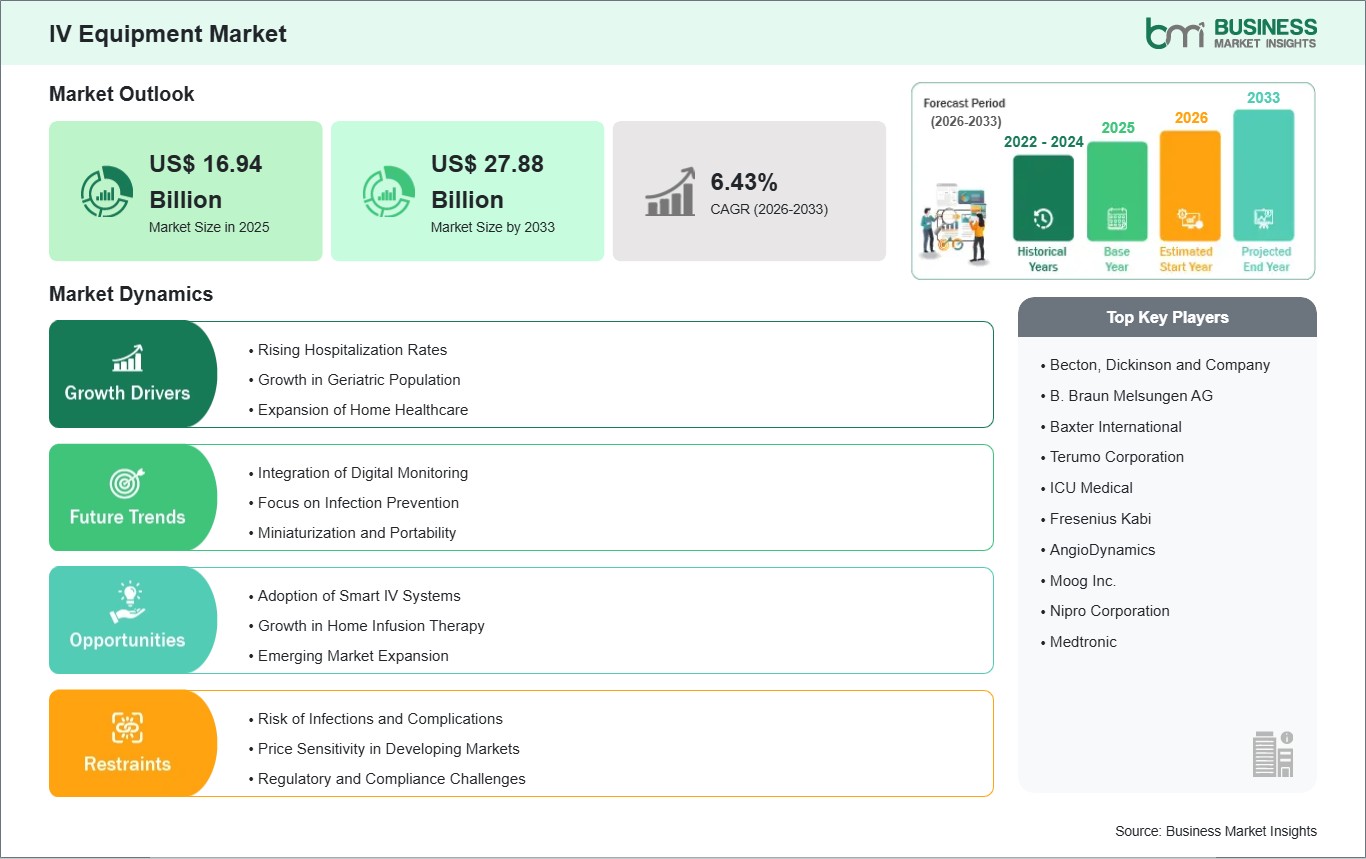
The IV Equipment Industry is experiencing steady growth worldwide, supported by the rising prevalence of chronic diseases, increasing hospitalization rates, an aging global population, and the growing demand for advanced drug delivery systems.
Download Sample Report : https://www.businessmarketinsights.com/sample/BMIPUB00032617
What Is IV Equipment?
IV (Intravenous) equipment refers to a specialized category of medical devices designed to deliver fluids, medications, blood products, and liquid nutrients directly into a patient's bloodstream. These devices are engineered for precision, hygiene, and patient safety, and are heavily deployed across hospitals, emergency care units, outpatient clinics, and home healthcare environments. They feature advanced fluid control mechanisms, sterile packaging, and highly engineered biocompatible materials designed to interact safely with human tissue while ensuring accurate therapeutic dosing.
Common IV equipment includes infusion pumps, intravenous catheters (peripheral and central venous), administration sets, securement devices, needleless connectors, and drip chambers. Modern infusion pumps increasingly feature digital controls, wireless connectivity, built-in drug libraries, and automated alarms to support more efficient and error-free clinical operations. The inclusion of these smart technologies ensures that the equipment can safely operate within fast-paced critical care zones where accurate volume and rate calculation are legally and medically enforced parameters.
Industry Drivers
A major driver of the IV Equipment Industry is the surge in global chronic disease prevalence, including cancer, cardiovascular disorders, diabetes, and gastrointestinal conditions. Treating these illnesses often requires prolonged administration of critical care fluids, chemotherapy drugs, and biologics. This rising clinical burden directly translates into robust, recurring supply and procurement orders for basic and advanced IV administration sets across healthcare networks.
The rapid expansion of ambulatory surgical centers (ASCs) and home healthcare settings is another important growth factor. As medical networks push to reduce prolonged hospital stays and lower overall healthcare costs, portable and user-friendly ambulatory infusion pumps have become extremely popular. This shift in care delivery allows patients to safely receive long-term intravenous therapies, such as antibiotics or parenteral nutrition, from the comfort of their homes, greatly expanding the addressable market for disposable and durable IV equipment.
Technological advancement and a heightened focus on infection control are further boosting demand. The development of closed-system transfer devices (CSTDs) and needle-free connectors has drastically reduced the incidence of needlestick injuries and catheter-related bloodstream infections (CRBSIs) among healthcare workers and patients. The widespread adoption of these safety-engineered devices is strongly supported by stringent healthcare regulations globally, ensuring sustained market penetration.
Get More Details: https://www.businessmarketinsights.com/buy/BMIPUB00032617
Industry Segmentation
By Product Type
- IV Catheters: The dominant segment globally, including peripheral and central venous catheters, essential for establishing primary vascular access.
- Infusion Pumps: High-value medical devices, including smart pumps and ambulatory variants, used to precisely control the flow rate of intravenous fluids.
- Administration Sets: The essential sterile tubing configurations used to connect the fluid source to the patient's catheter.
- Securement Devices: Products engineered to stabilize the catheter, preventing accidental dislodgement and reducing vascular trauma.
- Others: Incorporating needleless connectors, stopcocks, check valves, and drip chambers.
By Application
- Medication Administration: The leading application segment, covering the delivery of antibiotics, pain management drugs, and specialized biologics.
- Fluid and Electrolyte Replacement: Critical for rehydration therapies in emergency rooms and post-surgical recovery.
- Parenteral Nutrition: Providing essential liquid nutrients directly into the bloodstream for patients unable to digest food orally.
- Blood Transfusion: Specialized IV sets used for the safe and regulated delivery of blood and blood products.
By End User
- Hospitals and Clinics: The largest end-user segment, handling massive volumes of high-acuity patients requiring immediate and sustained IV access.
- Ambulatory Surgical Centers (ASCs): A rapidly growing segment utilizing advanced IV setups for same-day surgical procedures.
- Home Healthcare Settings: Expanding rapidly due to the rising adoption of portable infusion pumps for long-term chronic disease management.
The IV catheters segment dominates the industry due to its fundamental role in almost every intravenous procedure. Medication administration remains the leading application segment because of the universal clinical need for targeted drug delivery. Hospitals account for the largest consumer demographic, supported by vast medical infrastructure and high patient admission rates globally.
Regional Insights
- North America dominated the industry due to a highly developed healthcare infrastructure, strict clinical safety regulations, a rapidly aging population, and the widespread adoption of advanced smart infusion pumps. The U.S. serves as the primary hub for IV equipment innovation.
- Asia-Pacific is expanding rapidly, supported by growing healthcare expenditures, expanding hospital infrastructure, and a massive patient pool across China, India, and Japan. The rising prevalence of chronic illnesses in the region drives immense procurement volumes.
- Europe continues to grow steadily, driven by a strong focus on patient safety, stringent infection control mandates, and the rising popularity of home infusion therapies across the UK, Germany, and France.
- Middle East & Africa is seeing rising demand from ongoing investments in modern hospital networks and increasing government focus on expanding specialized critical care services.
- South & Central America remains an active market, with Brazil and Mexico leading regional procedural volumes due to growing healthcare access and expanding private clinical networks.
Top Players in the IV Equipment Industry
The industry is highly competitive, with leading medical device companies focusing on technological integration, safety enhancements, and strategic acquisitions to strengthen their global supply chains.
- Becton, Dickinson and Company (BD)
- B. Braun SE
- Baxter International Inc.
- Fresenius SE & Co. KGaA
- ICU Medical, Inc.
- Smiths Medical (ICU Medical)
- Terumo Corporation
- Moog Inc.
- Avanos Medical, Inc.
- AngioDynamics, Inc.
These companies continue to invest heavily in specialized R&D, aiming to develop closed-system safety catheters, sophisticated dose-error reduction software, and wireless hospital integration platforms.
Technological Innovations
Technological innovation is transforming the IV Equipment Industry. The deployment of Smart Infusion Pumps equipped with Dose Error Reduction Systems (DERS) allows hospitals to maintain pre-programmed drug libraries that automatically alert nurses to incorrect dosages, drastically reducing potentially fatal medication errors. Furthermore, the integration of these smart pumps with hospital Electronic Health Records (EHR) ensures seamless, real-time documentation of patient fluid intake.
Manufacturers are also rapidly advancing the design of safety-engineered consumables. The development of advanced needleless connectors and anti-reflux valves helps prevent blood from flowing backward into the IV line, minimizing clotting and lowering the risk of catheter-related bloodstream infections (CRBSIs). These innovations not only protect the patient but also safeguard nursing staff from hazardous needlestick injuries and exposure to toxic medications, such as chemotherapy drugs.
Additionally, the push toward specialized, miniaturized ambulatory pumps is another major trend. By combining lightweight ergonomics with robust digital monitoring, clinics can confidently discharge patients to home care settings, knowing their long-term IV therapy is being delivered accurately and safely.
Future Industry Outlook
The future outlook for the IV Equipment Industry remains highly positive. Rising hospitalization rates, the expanding prevalence of chronic medical conditions, continuous technological innovation in infusion safety, and a growing geriatric demographic are expected to support steady demand through 2034. The ongoing shift toward home-based infusion therapies will further cement portable IV equipment as a vital component of modern decentralized healthcare.
As smart hospital networks, wireless monitoring tools, and specialized safety catheters continue to advance, intravenous therapy will become even safer, more automated, and seamlessly integrated into digital patient records. Companies that focus on developing interoperable smart pumps, robust infection-control consumables, and global supply chain resilience are likely to capture the strongest growth opportunities in the coming years.
Frequently Asked Questions (FAQs)
What is the projected size of the IV Equipment Market by 2034?
The market is projected to reach US$ 29.11 Billion by 2034, rising from US$ 16.84 Billion in 2025.
What factors are driving industry growth?
Key drivers include the rising global prevalence of chronic diseases, the expansion of home healthcare and ambulatory surgery centers, and a strong regulatory push toward safety-engineered, error-reducing IV devices.
Which product segment dominates the industry?
IV Catheters currently hold the largest market share due to their essential, high-volume role in establishing vascular access for nearly all intravenous therapies.
Which region leads the industry?
North America dominates the industry due to a highly advanced healthcare system, substantial healthcare spending, and widespread adoption of smart infusion technologies.
Browse More Reports:
https://www.businessmarketinsights.com/reports/medical-sensors-market
https://www.businessmarketinsights.com/reports/airway-management-devices-market
https://www.businessmarketinsights.com/reports/therapeutic-drug-monitoring-market
About Us
Business Market Insights is a market research platform that provides subscription service for industry and company reports. Our research team has extensive professional expertise in domains such as Electronics & Semiconductor; Aerospace & Defense; Automotive & Transportation; Energy & Power; Healthcare; Manufacturing & Construction; Food & Beverages; Chemicals & Materials; and Technology, Media, & Telecommunications.
Contact Us
If you have any questions about this report or would like further information, please contact us:
Contact person: Ankit Mathur
Email: sales@businessmarketinsights.com
Phone: +16467917070