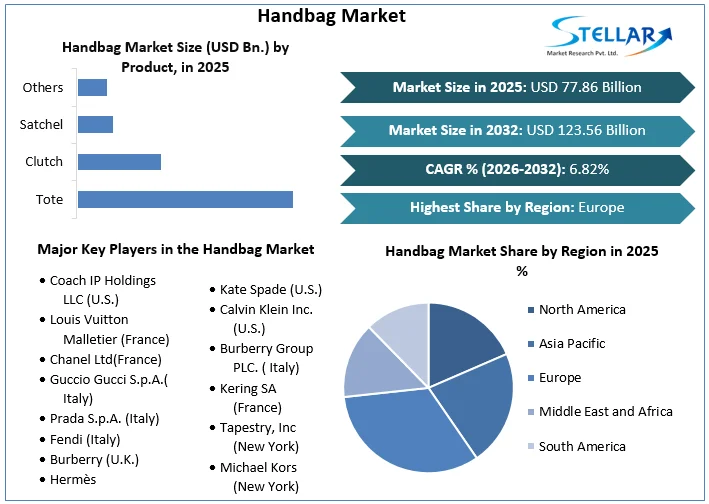
PUNE, June 18, 2026 — The Handbag Market is entering a new phase of transformation as sustainability, premium fashion demand, and digital retail innovation redefine consumer purchasing behavior. According to the latest Handbag Market Report published by Stellar Market Research, the market was valued at USD 77.86 Billion in 2025 and is expected to reach USD 123.56 Billion by 2032, growing at a CAGR of 6.82% during 2026–2032. The report highlights how luxury brands, direct-to-consumer channels, and eco-conscious product development are creating new growth opportunities across established and emerging markets.
Market Opportunity Overview
The global handbag industry is evolving beyond its traditional role as a fashion accessory. Consumers increasingly view handbags as lifestyle products that combine functionality, personalization, sustainability, and brand identity. Premiumization trends, particularly among millennials and Gen Z consumers, are driving demand for luxury and aspirational brands.
At the same time, the expansion of digital commerce, influencer-led purchasing behavior, and social commerce platforms is reshaping how handbags are discovered, marketed, and sold. Manufacturers are responding with sustainable materials, limited-edition collections, omnichannel retail strategies, and technology-enabled customer experiences.
The market is also benefiting from rising disposable incomes in emerging economies, increased participation of women in the workforce, and growing demand for versatile products suitable for work, travel, and everyday use.
Download Free PDF Brochure:https://www.stellarmr.com/report/req_sample/Handbag-Market/528
Key Findings from the Report
- The Handbag Market was valued at USD 77.86 Billion in 2025 and is projected to reach USD 123.56 Billion by 2032.
- Europe holds the largest market share, supported by the presence of luxury fashion houses and strong consumer spending on premium accessories.
- The tote bag segment remains the dominant product category due to its practicality and broad consumer appeal.
- Satchel handbags are emerging as one of the fastest-growing segments driven by professional and multifunctional use cases.
- Leather handbags continue to dominate material demand because of durability, luxury appeal, and premium positioning.
- Women remain the largest end-user segment, while men's luxury accessories are gaining momentum globally.
- Asia-Pacific is emerging as the fastest-growing regional opportunity, led by China, India, and Southeast Asian economies.
Market Drivers and Restraints
Key Drivers
Growing Fashion Consciousness and Premiumization
Consumers increasingly perceive handbags as status symbols and fashion investments, driving demand for luxury and designer collections.
Expansion of E-commerce and Digital Retail
Online platforms are enabling brands to reach wider audiences, improve personalization, and offer seamless omnichannel experiences.
Rising Disposable Income in Emerging Economies
Growing middle-class populations in Asia-Pacific, Latin America, and the Middle East are supporting demand for branded handbags across multiple price segments.
Market Restraints
Counterfeit Products and Brand Dilution
The proliferation of counterfeit handbags continues to affect brand value and consumer trust across several markets.
Volatility in Raw Material Costs
Fluctuations in leather, synthetic materials, and transportation costs can impact profit margins and pricing strategies.
Technology, Regulation, and Sustainability Trends
The handbag industry is increasingly integrating digital technologies to enhance customer engagement and operational efficiency. Artificial intelligence is supporting demand forecasting, inventory optimization, and personalized recommendations.
Sustainability has become a major competitive differentiator. Brands are investing in vegan leather, recycled textiles, bio-based materials, and circular economy initiatives to align with evolving consumer expectations. Regulatory pressure around environmental disclosures and supply chain transparency is also encouraging manufacturers to adopt responsible sourcing practices.
Blockchain-enabled traceability, digital product passports, and carbon-footprint reporting are emerging as strategic tools for premium brands seeking stronger ESG positioning.
Download Free PDF Brochure:https://www.stellarmr.com/report/req_sample/Handbag-Market/528
Recent Industry Developments
Louis Vuitton (2025): Expanded its sustainable sourcing initiatives and increased investment in traceable luxury materials, strengthening premium market positioning.
Gucci (2025): Introduced additional circular fashion and resale programs designed to extend product lifecycles and attract environmentally conscious consumers.
Prada Group (2025): Expanded Re-Nylon collections and sustainable material integration, supporting broader luxury sustainability adoption.
Tapestry Inc. (2025): Accelerated digital commerce investments and AI-enabled customer engagement programs to improve omnichannel sales performance.
Coach (2024): Expanded sustainability-focused product lines utilizing recycled and lower-impact materials, reinforcing consumer demand for responsible fashion.
Regional Insights
Europe: Market Leader
Europe remains the leading region in the handbag market due to the concentration of luxury brands, strong tourism-driven sales, and high consumer preference for premium accessories. France, Italy, Germany, and the United Kingdom continue to serve as major innovation and manufacturing hubs.
Asia-Pacific: Emerging Growth Engine
Asia-Pacific is expected to generate the strongest growth opportunities throughout the forecast period. China remains a major luxury consumer market, while India's rapidly expanding middle class, increasing fashion awareness, and growing online retail penetration are creating substantial opportunities for both premium and affordable brands.
North America
North America continues to benefit from strong luxury spending, digital retail adoption, and growing demand for premium lifestyle products. The United States remains a key revenue contributor for global brands.
Competitive Landscape
The market remains highly competitive, characterized by established luxury brands and emerging fashion companies pursuing differentiation through innovation, sustainability, and digital engagement.
Key market participants include Louis Vuitton, Chanel, Gucci, Prada, Hermès, Burberry, Tapestry Inc., and Michael Kors.
Companies are increasingly investing in digital transformation, sustainable materials, product diversification, strategic collaborations, and direct-to-consumer business models to strengthen competitive positioning.
Analyst Commentary
"The next phase of growth in the handbag market will be defined by the convergence of sustainability, premiumization, and digital engagement. Brands that successfully combine responsible sourcing with personalized consumer experiences will be best positioned to capture long-term value creation opportunities," said a Senior Research Analyst at Stellar Market Research.
Future Outlook
Through 2032, the handbag market is expected to witness sustained expansion driven by premium fashion demand, increasing adoption of sustainable materials, and continuous innovation in digital retail. Investment activity is likely to focus on supply-chain transparency, ESG compliance, omnichannel commerce, and product customization.
Emerging economies will remain critical growth engines, while established luxury markets continue to drive profitability through premium product offerings. The combination of sustainability, technology integration, and evolving consumer lifestyles is expected to reshape competitive dynamics across the industry.
About Stellar Market Research
Stellar Market Research is a global market research and business consulting firm providing actionable insights across manufacturing, consumer goods, healthcare, technology, chemicals, automotive, and industrial sectors. The company delivers data-driven intelligence through comprehensive market reports, competitive benchmarking, trend analysis, and strategic advisory services. With a strong focus on accuracy, industry expertise, and client-centric research methodologies, Stellar Market Research helps organizations identify growth opportunities, manage risks, evaluate investments, and make informed business decisions in rapidly evolving markets. Its research solutions support corporate executives, investors, policymakers, and industry stakeholders worldwide.
Media Contact
Stellar Market Research
Address: Phase 3, Navale IT Zone, S.No. 51/2A/2, Office No. 202, 2nd Floor, Near Navale Bridge, Narhe, Pune, Maharashtra 411041
Website: http://stellarmr.com/
Email: sales@stellarmr.com
Mobile: +91 9607365656