PUNE, June 18, 2026 The Food Container Market, according to a recent study by Stellar Market Research, is witnessing accelerated transformation as sustainability regulations, food delivery growth, and innovations in recyclable packaging redefine industry priorities. The market continues to attract investment from packaging manufacturers, food processors, retailers, and logistics providers seeking durable, lightweight, and environmentally compliant packaging solutions. The report forecasts steady growth through 2032, supported by rising packaged food consumption, urbanization, and advancements in material technologies.
Market Opportunity Overview
The food packaging industry is entering a new phase where environmental responsibility is becoming as important as product protection. Increasing scrutiny of single-use plastics, coupled with the rapid growth of e-commerce food delivery and convenience foods, is creating demand for next-generation food containers.
Manufacturers are shifting toward recyclable plastics, reusable formats, lightweight glass packaging, fiber-based containers, and smart packaging technologies that enhance shelf life and traceability. The transition is generating opportunities for packaging suppliers, material innovators, recycling companies, and food brands seeking to align with sustainability targets while maintaining operational efficiency.
The growing influence of ESG commitments among global food companies is further accelerating investments in circular packaging ecosystems, creating long-term opportunities across the value chain.
Download Free PDF Brochure:https://www.stellarmr.com/report/req_sample/Food-Container-Market/354
Key Findings from the Report
- The Food Container Market is projected to maintain steady growth through the forecast period ending in 2032.
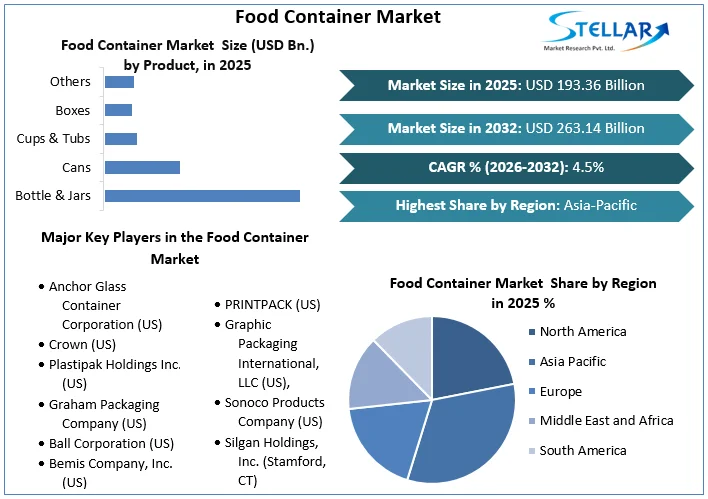
- Bottle & Jars accounted for the largest product segment with approximately 32.4% market share in 2025.
- The Cans segment is expected to record one of the fastest growth rates, expanding at approximately 4.5% CAGR during the forecast period.
- By material, Plastic remained dominant, representing around 39.4% of market demand in 2025 due to affordability and versatility.
- Glass containers are emerging as a high-growth segment as consumers increasingly prefer transparent and reusable packaging solutions.
- Asia-Pacific continues to lead global demand, supported by expanding food processing industries, urbanization, and rising packaged food consumption.
- Investments in sustainable packaging infrastructure are becoming a key differentiator for manufacturers and institutional investors.
Market Drivers and Restraints
Key Drivers
Growth of Packaged and Ready-to-Eat Foods
Changing consumer lifestyles, increasing workforce participation, and demand for convenience foods continue to expand the need for reliable food storage and transportation solutions.
Expansion of Food Delivery and E-Commerce
Online grocery platforms and food delivery services require durable packaging capable of preserving freshness during transportation, driving container demand across multiple formats.
Sustainability-Focused Innovation
Brands are increasingly adopting recyclable, reusable, and bio-based packaging materials to meet consumer expectations and regulatory requirements, creating new growth opportunities.
Key Restraints
Volatility in Raw Material Costs
Fluctuating prices of plastics, metals, paperboard, and glass can impact profitability and increase pricing pressures across the supply chain.
Stringent Environmental Regulations
Restrictions on single-use plastics and evolving compliance requirements create challenges for manufacturers dependent on traditional packaging materials.
Technology, Regulation, and Sustainability Trends
Digital manufacturing technologies, automation, and material science innovations are reshaping food container production. Smart packaging solutions featuring freshness indicators, QR-code traceability, and improved barrier properties are gaining adoption.
Governments across Europe, North America, and Asia-Pacific are strengthening regulations related to plastic waste reduction and recycling targets. These policies are accelerating the commercialization of compostable materials, mono-material packaging structures, and reusable container systems.
Sustainability has evolved from a marketing initiative to a strategic business requirement. Companies investing in circular economy models, recycled content integration, and low-carbon packaging solutions are expected to gain competitive advantages over the forecast period.
Download Free PDF Brochure:https://www.stellarmr.com/report/req_sample/Food-Container-Market/354
Recent Industry Developments
Amcor (2025): Expanded recyclable packaging solutions for food applications, supporting global sustainability commitments and reducing virgin plastic dependency.
Berry Global (2025): Increased investment in circular packaging technologies and recycled-content food containers, strengthening its sustainability portfolio.
Tetra Pak (2025): Introduced enhanced food packaging solutions incorporating renewable and recycled materials to support food industry decarbonization goals.
Sonoco Products (2024): Expanded sustainable rigid packaging offerings and strengthened partnerships focused on recyclable food packaging formats.
Ball Corporation (2024): Increased investments in aluminum food packaging capacity, benefiting demand for infinitely recyclable container solutions.
Regional Insights
Leading Region: Asia-Pacific
Asia-Pacific remains the largest regional market due to rapid urbanization, rising disposable incomes, expanding food processing industries, and strong demand from China, India, Japan, and Southeast Asian economies. Growth in modern retail channels and food delivery platforms continues to strengthen regional consumption.
Emerging Region: Middle East and Africa
The Middle East and Africa are emerging as attractive markets driven by population growth, expanding food retail infrastructure, tourism-related demand, and increasing investments in food manufacturing capabilities. Governments are also encouraging local packaging production to reduce import dependence.
North America and Europe
These regions continue to lead in sustainable packaging innovation, regulatory compliance, and premium food packaging adoption. Demand is increasingly influenced by recycling targets and consumer preference for environmentally responsible packaging solutions.
Competitive Landscape
The Food Container Market remains highly competitive with global and regional manufacturers investing in product innovation, sustainability initiatives, strategic partnerships, and production expansion.
Leading companies include Amcor plc, Berry Global, Ball Corporation, Sonoco Products Company, Silgan Holdings, Ardagh Group, Plastipak Holdings, Graham Packaging, Weener Plastics, and Tetra Pak. These companies are focusing on recyclable materials, lightweight packaging, operational efficiency improvements, and strategic collaborations with food manufacturers to strengthen market positioning.
Analyst Commentary
"The next phase of growth in the Food Container Market will be defined by the industry's ability to balance sustainability, affordability, and functionality. Companies that successfully integrate circular packaging solutions while maintaining product performance will be best positioned to capture long-term market share," said a Senior Research Analyst at Stellar Market Research.
Future Outlook
Through 2032, the Food Container Market is expected to benefit from continued growth in packaged food consumption, expanding e-commerce channels, sustainability-driven investments, and regulatory support for recyclable packaging. Material innovation, smart packaging integration, and circular economy initiatives are likely to become key competitive differentiators.
As food manufacturers increasingly prioritize supply-chain resilience and environmental compliance, demand for advanced food containers is expected to remain strong across both developed and emerging economies.
About Stellar Market Research
Stellar Market Research is a global market research and business consulting firm delivering actionable intelligence across diverse industries. The company provides comprehensive market assessments, competitive benchmarking, technology analysis, industry forecasting, and strategic advisory services that help organizations make informed business decisions. Through a combination of primary research, secondary analysis, and advanced forecasting methodologies, Stellar Market Research enables businesses, investors, and policymakers to identify emerging opportunities, evaluate market risks, and develop growth strategies. The firm's industry expertise spans manufacturing, healthcare, consumer goods, packaging, chemicals, technology, energy, and industrial sectors worldwide.
Media Contact
Stellar Market Research
Address: Phase 3, Navale IT Zone, S.No. 51/2A/2, Office No. 202, 2nd Floor, Near Navale Bridge, Narhe, Pune, Maharashtra 411041
Website: http://stellarmr.com/
Email: sales@stellarmr.com
Mobile: +91 9607365656