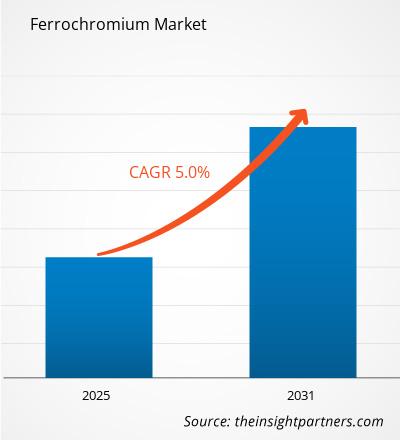
Every stainless-steel kitchen sink, chemical tank and surgical tool owes its shine and corrosion resistance to chromium, and ferrochromium is the main way that chromium enters steel. That quiet but essential role underpins the Ferrochromium Market, which is expected to climb from US$ 19.40 Billion in 2025 to US$ 26.07 Billion by 2034, registering a CAGR of 3.34% during 2026 to 2034. Growth here is measured rather than flashy, yet the ferrochromium market rests on some of the most dependable industrial demand in the world.
What Is Ferrochromium?
Ferrochromium is an alloy of chromium and iron produced by smelting chromite ore with a reducing agent in electric arc furnaces. It supplies chromium to steelmakers, giving stainless and alloy steels their hardness, heat tolerance and resistance to rust. Producers also sell by-products such as slag and fine powder for construction, refractory and metallurgical uses.
Request a Sample Copy of the Report: https://www.theinsightpartners.com/sample/TIPRE00016175
What Is Driving Demand in the Ferrochromium Market?
Stainless steel is the centre of gravity. Construction, rail, food processing, appliances, energy equipment and automotive exhaust systems all rely on corrosion-resistant steels, and every tonne of stainless-steel needs chromium. As urbanisation and infrastructure spending continue across Asia and other emerging regions, steel mills keep buying ferrochromium to feed expanding stainless output. That link is direct and durable, which is why the ferrochromium market tends to follow the stainless-steel cycle closely.
Industrial performance adds a second layer. Ball bearing steels depend on chromium for hardness and wear resistance, while acid resistant steels serve chemical plants, refineries and fertiliser facilities where aggressive fluids would destroy ordinary metal. Cast irons use chromium to improve abrasion resistance in mining equipment, pumps and grinding media. So what keeps these buyers coming back? Reliability under harsh conditions. When a component must survive years of friction, heat or corrosion, alloy specifications leave little room for substitutes.
Beyond that, energy transition and manufacturing trends play a part. Wind turbines, power plants, hydrogen equipment and rail networks require durable steels, and the push toward electric vehicles and advanced machinery supports demand for high-quality alloy grades. Powder metallurgy is another niche, where ferrochromium powder helps create precisely engineered parts with consistent properties. By-products create extra value too, since ferrochromium slag finds use as aggregate in road building and civil engineering, as well as in refractory materials.
Challenges remain, of course. Smelting consumes large amounts of electricity, so power prices strongly influence production costs and plant economics. Chromite ore supply is concentrated in a few countries, and trade policy, transport costs and environmental regulation can shift supply quickly. Producers that secure low-cost power, stable ore supply and efficient furnace operations are best placed to protect margins in the ferrochromium market.
Segmentation Overview of the Ferrochromium Market
By Form: Ferrochromium slag is generated during smelting and is used in construction aggregates, road base and refractory applications, turning a by-product into a revenue stream. Ferrochromium powder is a finer product valued in powder metallurgy, welding materials and specialised alloy production where particle size and purity matter.
By Application: Ball bearing steels use chromium to deliver hardness and fatigue resistance in precision components. Acid resistant steels protect equipment in chemical, petrochemical and fertiliser industries. Cast irons gain wear resistance for mining, cement and heavy machinery parts. Powder metallurgy relies on fine alloy powders to shape complex components with minimal waste. The Others category covers civil engineering and refractory materials, where slag and related products add strength and heat resistance.
Key Market Players in the Ferrochromium Market
- Aarti Steels Ltd
- Balasore Alloys Limited
- Nava Bharat Ventures Limited
- SR Group
- VISA STEEL
- Vyankatesh Metals and Alloys Pvt. Ltd
- Others
Several of the profiled companies, including Balasore Alloys, Nava Bharat Ventures, Visa Steel and Aarti Steels, are linked with Indian ferroalloy and steel production, where access to chromite ore and integrated power operations shapes competitiveness. SR Group and Vyankatesh Metals and Alloys add further regional capacity and supply relationships with steelmakers. Competition centres on ore access, power costs, product consistency and delivery reliability, while smaller specialists compete through niche grades and customer service.
Sustainability and Innovation Trends in Ferrochromium
Energy efficiency is the strongest sustainability theme. Producers are modernising furnaces, recovering waste heat, adopting pre-heating of raw materials and exploring renewable electricity to lower carbon emissions per tonne of alloy. Slag utilisation is another priority, with processors refining and certifying slag for road construction and other civil uses to cut landfill volumes. Stainless steel recycling also supports circularity, since scrap supplies reduce the need for virgin alloy in some applications, even as demand for primary ferrochromium stays strong. As environmental regulation tightens and buyers demand lower-carbon materials, cleaner smelting will increasingly set suppliers apart in the ferrochromium market.
Buy Premium Report: https://www.theinsightpartners.com/buy/TIPRE00016175
Regional Outlook
Asia Pacific is widely regarded as the centre of both production and consumption, led by large stainless steel industries in China and India alongside strong output in Japan and South Korea. Europe consumes significant volumes through its stainless steel, automotive and machinery sectors and focuses heavily on lower-carbon production and recycling. North America relies on stainless and alloy steel demand from construction, energy and manufacturing, with a strong emphasis on supply security. South and Central America is developing gradually, with mining and steel projects creating opportunities for local alloy supply and value-added processing.
Related Reports:
Steel Mills Products Market Share, Size & Demand by 2034
Wear Resistant Steel Plate Market Size, Demand & Growth by 2034
Flat Steel Market Size, Share & Trends by 2034
About The Insight Partners
The Insight Partners is among the leading market research and consulting firms in the world. We take pride in delivering exclusive reports along with sophisticated strategic and tactical insights into the industry. Reports are generated through a combination of primary and secondary research, solely aimed at giving our clientele a knowledge-based insight into the market and domain. This is done to assist clients in making wiser business decisions. A holistic perspective in every study undertaken forms an integral part of our research methodology and makes the report unique and reliable.
Contact Us:
If you have any queries about this report or if you would like further information, please contact us:
Phone: +1-646-491-9876
E-mail: sales@theinsightpartners.com
Also Available in: Korean | German | Japanese | French | Chinese | Italian | Spanish