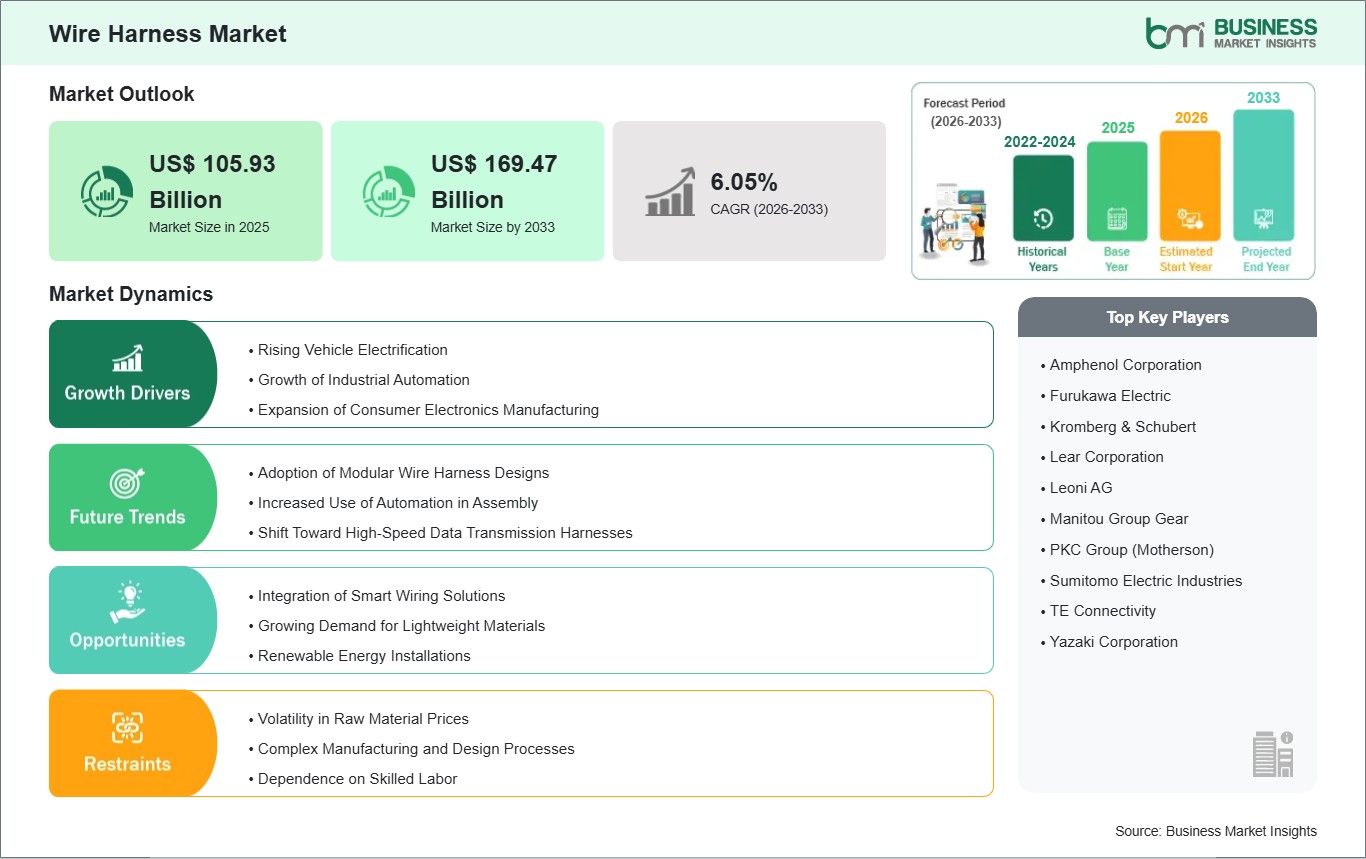
The global Wire Harness Industry is experiencing a profound technological and structural expansion, moving away from historical reliance on standard manual routing layouts toward highly engineered, high-density electrical distribution and signal transmission networks. Wire harnesses encompass an advanced array of bundled cables, heavy-duty connectors, and specialized terminals explicitly calibrated to streamline the routing of complex circuitry across multi-system environments.
According to Business Market Insights, the global Wire Harness Market size is expected to reach US$ 169.47 Billion by 2033 from US$ 105.93 Billion in 2025. The market is estimated to record a CAGR of 6.05% from 2026 to 2033.
Advancements in high-speed automated crimping machinery, ultra-lightweight shielding fabrics, modular connection points, specialized thermoplastic coverings, and localized ultrasonic welding models are rapidly shifting the competitive environment. Leading industrial manufacturing firms are funneling substantial capital into consolidating multi-wire systems into low-profile modular arrays, introducing intelligent electromagnetic interference (EMI) protection fields, and embedding robust environmental sealings directly into terminal configurations. These investments are specifically engineered to eliminate electrical short circuit hazards, reduce institutional structural weight, and provide a durable, digitized interconnectivity matrix that seamlessly integrates with modern automated smart vehicles, commercial fleets, and advanced defense grids.
What Is a Wire Harness?
A wire harness is an advanced, highly engineered assembly of electrical cables, wires, and termination points designed to transmit electrical power and informational signals smoothly across distinct systems. Far exceeding basic bulk wiring configurations, these modernized layouts operate as the definitive central nervous system within complex mechanical and electronic equipment. They incorporate sophisticated structural layers such as heavy-duty protective sleeving, insulating tapes, conduit channels, and specialized routing ties that secure multiple wire branches into a single consolidated bundle, ensuring clean spatial layouts, localized electrical insulation, and maximum protection against abrasion, moisture ingress, and ambient vibrational stresses.
These organized interconnection frameworks utilize highly specific functional elements to handle extreme voltage and signal variations. At the terminal level, Connectors and Contact Terminals act as the critical linkage between individual wire strands and electronic sub-assemblies, establishing secure physical retention and bidirectional signal flow without operational interruption. These compiled circuits travel safely through specialized protective jackets made from high-grade polymers, which isolate physical currents and mitigate external risks, allowing operators to deploy massive electronic configurations safely within cramped engine compartments, high-stress aviation bays, and heavy-duty manufacturing environments without structural degradation.
Download Sample Report: https://www.businessmarketinsights.com/sample/BMIPUB00032697
Market Drivers
A primary driver accelerating the global Wire Harness Industry is the critical focus on Automotive Electrification and Electronic Content Proliferation. Conventional internal combustion platforms are being rapidly outpaced by hybrid and battery electric vehicle (EV) architectures that integrate intensive arrays of cameras, ADAS sensors, high-voltage battery links, and extensive infotainment layouts. Wire harnesses address the resulting design challenges by providing highly specialized, high-voltage distribution networks capable of managing massive electrical currents alongside low-voltage data lines. This expansion significantly boosts the overall wire count and component complexity per vehicle, establishing a robust foundation for next-generation mobility networks.
The global push for a Shift Toward Lightweight and High-Performance Materials represents another core market driver. As commercial transport operators and aerospace engineering networks face intense regulatory targets to decrease carbon outputs and improve baseline operational fuel metrics, heavy standard component mass must be strictly eliminated. Wire harness developers utilize advanced, lightweight alternative insulations such as Thermoplastic Elastomers (TPE) and Polyurethane to replace traditional heavy PVC layouts without sacrificing dielectric strengths or thermal thresholds. This optimizes payload metrics for transport lines and maximizes efficiency across high-throughput industrial systems.
Additionally, the universal transition toward Industrial Automation, Renewable Infrastructure, and Telecom expansion acts as a powerful catalyst. To satisfy international manufacturing efficiency guidelines and support expansive smart factory systems, multi-axis industrial robotics and wind/solar generation centers require robust, custom-engineered cabling layouts. Wire harnesses supply the precise physical routing and structural flexibility necessary to survive non-stop mechanical flex cycles, safely protecting localized control systems from catastrophic data disconnects or high-stress operational failures.
Market Segmentation
By Component
- Connectors (Commanding a leading position within the market in 2024 due to the continuous modularization of electronics and the widespread necessity for secure, plug-and-play circuit mating points)
- Terminals (Expanding steadily as automation lines and high-vibration automotive systems demand premium crimped terminations to guarantee uninterrupted conductivity)
- Others (Comprising protective conduits, specialized routing clips, wrapping tapes, and heat-shrink sleeves required to safeguard structural harness integrity)
By Material
- PVC (Polyvinyl Chloride) (Holding the largest market share in 2024 supported by its outstanding cost-efficiency, excellent dielectric insulation, and highly adaptable physical characteristics across general use-cases)
- Thermoplastic Elastomer (TPE) (Tracking high growth across heavy industrial and automotive sectors due to superior flex life, advanced temperature resilience, and low-weight profiles)
- Polyurethane & Polyethylene (Favorably deployed in moisture-heavy or chemically abrasive contexts requiring extreme resistance to fluid ingress and tearing forces)
- Vinyl (Utilized across cost-sensitive commercial goods and basic consumer appliances requiring standard electronic routing configurations)
By End-User Industry
- Automotive (The premier volume-generating vertical, capturing the dominant market share in 2024 propelled by the complex wiring requirements of electric drivetrains and smart digital cabins)
- Aerospace & Defense (Demanding high-premium, custom-engineered variations built with radical fire-retardant insulations and severe EMI shielding to withstand extreme altitude conditions)
- Industrial & Agriculture (Utilizing highly ruggedized, heavy-duty wire harness arrays to maintain continuous uptime within automated factory floors and high-stress field machinery)
- Consumer Durables (Securing steady volume demand via home appliances, white goods, and localized climate control systems requiring compact internal electronics connectivity)
- Medical, Marine, and Others (Expanding through highly specialized niches, including water-resistant marine outboards and sterilized, highly flexible cabling profiles for medical diagnostic units)
Get More Insights: https://www.businessmarketinsights.com/buy/BMIPUB00032697
Regional Insights
- Asia-Pacific holds the premier position in the global landscape, securing a dominant market share and marking the fastest growth path through the forecast window. This commanding stance is anchored by the presence of massive automotive production lines, extensive electronics manufacturing ecosystems across China, Japan, and South Korea, and expanding public infrastructure networks in India.
- North America exhibits a highly structured, substantial market presence, heavily focused on high-value aerospace assemblies, luxury automotive lines, and strict safety-compliant defense infrastructure modernization initiatives across the United States and Canada.
- Europe maintains a highly robust, premium-market footprint, characterized by strict automotive environmental targets and advanced industrial automation standards. European implementations prioritize high-performance TPE integrations to satisfy vehicle weight reductions and circular-economy resource mandates.
- Rest of the World is displaying steady, progressive growth patterns, driven by ongoing telecommunication network expansions in Latin American hubs, growing industrial assembly localization in the Middle East, and targeted mining equipment retrofits across South Africa.
Top Players in the Industry
The competitive ecosystem displays a sophisticated matrix of diversified multinational automotive component brands and specialized precision electronics manufacturers executing long-term framework supply agreements with vehicle OEMs and heavy industrial integrators.
- Sumitomo Electric Industries, Ltd.
- Yazaki Corporation
- Aptiv PLC
- Leoni AG
- Lear Corporation
- Furukawa Electric Co., Ltd.
- TE Connectivity Ltd.
- Molex, LLC
- Samvardhana Motherson International Ltd.
- PKC Group (MSSL)
Technological Innovations
The commercial implementation of advanced Automated High-Speed Wire Processing Systems and Ultrasonic Welding Techniques represents a monumental structural breakthrough for the wire harness sector. Historically, harness layout fabrication was highly labor-intensive, relying on physical assembly boards and manual terminal splicing, which increased human error risks and baseline resistance fluctuations across connection points. Next-generation automated lines utilize advanced software systems to feed, measure, cut, strip, and crimp micro-wires within fractions of a second with exact positioning accuracy. When paired with localized ultrasonic welding, wire nodes are fused into single, homogeneous electrical structures, completely removing the reliance on external crimp terminals, cutting down physical block sizes, and significantly lowering operational resistance metrics.
Concurrently, the integration of High-Performance Shielding and Multi-Core Optical Integration is completely modernizing the data-routing landscape. Modern automated vehicles generate intense electromagnetic fields that risk corrupting high-fidelity camera or radar signals passing through standard copper strands. To address this exposure, leading manufacturers are embedding highly dense, lightweight aluminum-metallized wrapping foils and miniature fiber-optic pathways directly into main harness trunks. These integrated optical pathways seamlessly transmit gigabit-per-second data volumes without experiencing signal degradation from neighboring power cables, guaranteeing robust data safety across critical autonomous driving paths.
Future Market Outlook
The long-term trajectory for the Wire Harness Market remains exceptionally robust. As national vehicular frameworks permanently establish advanced safety features as baseline standard equipment and global industrial complexes continue to expand their dependency on multi-axis automated machinery, the universal demand for intelligent, lightweight wire harness configurations will scale continuously, defining point-of-care electrical connectivity standards.
Future research and development capital will be heavily directed toward the commercialization of fully automated robotic harness installation layouts to eliminate final manual vehicle assembly bottlenecks, the development of high-voltage bio-based polymer insulations to minimize environmental lifecycles, and the expansion of smart, embedded circuit sensors capable of signaling real-time insulation wear. Assembly developers that successfully balance premium lightweight material availability with highly competitive, automated mass production capabilities will comfortably secure long-term global market leadership.
Frequently Asked Questions (FAQs)
What is the projected valuation of the global wire harness market by 2033?
The global wire harness market is projected to reach a valuation of US$ 169.47 Billion by 2033, expanding significantly from its established baseline value of US$ 105.93 Billion in 2025.
What is the expected compound annual growth rate (CAGR) of the market over the forecast window?
The market is anticipated to expand at a steady Compound Annual Growth Rate (CAGR) of 6.05% during the forecast timeline spanning from 2026 through 2033.
Which material segment currently holds the largest share in the global market?
The PVC (Polyvinyl Chloride) segment holds the leading market share because it delivers an exceptional combination of cost-effectiveness, strong electrical insulation, and chemical adaptability for general consumer and industrial lines.
How is vehicle electrification changing traditional wire harness designs?
Electrification requires wire harnesses to handle extreme high-voltage architectures (often up to 800V) which necessitates heavy-duty shielding, specialized orange-coded outer insulation jackets, and premium heat dissipation materials to manage rising thermal dynamics safely.
Browse More Reports:
Access Control as a Service Market
About Us
Business Market Insights is a market research platform that provides subscription service for industry and company reports. Our research team has extensive professional expertise in domains such as Electronics & Semiconductor; Aerospace & Defense; Automotive & Transportation; Energy & Power; Healthcare; Manufacturing & Construction; Food & Beverages; Chemicals & Materials; and Technology, Media, & Telecommunications.
Contact Us
If you have any questions about this report or would like further information, please contact us:
Contact person: Ankit Mathur
Email: sales@businessmarketinsights.com
Phone: +16467917070