Key Highlights
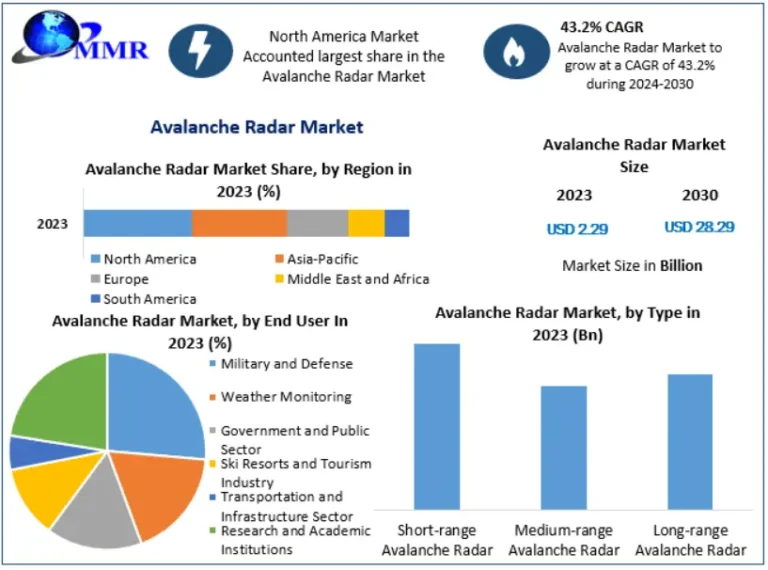
- Avalanche Radar Market was valued at USD 2.29 billion in 2023.
- Market revenue is expected to reach nearly USD 28.29 billion by 2030.
- Forecast CAGR stands at 43.2% between 2024 and 2030.
- North America remains the largest regional market.
- Long-range avalanche radar represents the dominant type segment.
- Processors lead the component segment due to their role in real-time data analysis.
- Military and defense applications are emerging as a major growth catalyst.
- Competitive activity centers on technology enhancement, partnerships, acquisitions, and distribution expansion.
Why This Matters Now
Defense agencies, transportation authorities, and infrastructure operators are confronting rising operational risks in mountainous regions. Avalanche events can disrupt military logistics, close strategic transport corridors, and threaten critical public infrastructure.
The commercial opportunity extends beyond traditional snow safety programs. Governments are increasingly treating avalanche monitoring as part of broader resilience and national security planning. For radar manufacturers, software providers, and defense contractors, this creates a rapidly expanding procurement pipeline with recurring technology upgrade requirements.
Market Overview
The Avalanche Radar Market is entering a high-growth phase as governments and infrastructure operators invest in automated hazard detection systems. According to Maximize Market Research, the market was valued at USD 2.29 billion in 2023 and is projected to grow at a CAGR of 43.2% through 2030, reaching nearly USD 28.29 billion.
Avalanche radar systems provide early-warning capabilities by detecting snow movement and avalanche activity across large terrain areas. Unlike conventional localized sensors, radar systems can monitor extensive slopes from a single installation while maintaining performance during adverse weather conditions and low-visibility environments. Their operational range can extend up to five kilometers, making them particularly valuable for transportation infrastructure, military operations, and public safety applications.
The market's expansion is not simply a safety story. It is increasingly becoming a strategic technology market tied to infrastructure resilience, disaster preparedness, and defense readiness.
Key Trends Driving Growth
Military and defense organizations are becoming increasingly important customers. Operations in mountainous terrain expose personnel, equipment, and supply routes to avalanche risks. Radar-based monitoring provides commanders with actionable intelligence and improves operational continuity in challenging environments. This trend is creating a new procurement channel beyond traditional civilian avalanche forecasting applications.
Search-and-rescue modernization is another growth driver. Avalanche radar systems can identify buried victims beneath snowpack by transmitting and receiving radar waves capable of penetrating snow layers. Faster detection significantly improves rescue outcomes and increases demand from emergency response organizations.
Technology innovation is shifting competitive advantage toward companies capable of delivering higher processing power and faster analytics. The growing importance of data interpretation, automated alerts, and real-time monitoring is elevating software and processing capabilities from supporting functions to primary value drivers.
The market also benefits from broader investments in transportation safety. Rail networks, mountain highways, and strategic corridors increasingly require automated hazard monitoring systems that reduce disruption risks and improve infrastructure availability throughout winter seasons.
Get a deeper look at the data by requesting a sample report today
Segment Insights
- Dominant Type Segment: Long-range avalanche radar held the largest market share in 2023. Its ability to monitor extensive mountainous terrain from a single installation provides operational and economic advantages for governments, transportation authorities, and defense users.
- Technology Segments: The market includes Frequency Modulated Continuous Wave (FMCW) radar and pulsed radar technologies. Both technologies support detection and monitoring requirements across diverse operating environments.
- Dominant Component Segment: Processors accounted for the leading component position in 2023. Their role in analyzing radar data, extracting actionable insights, and enabling real-time decision-making makes them critical to system performance.
- Key Applications: Avalanche forecasting and warning systems, search and rescue operations, ski resort safety, transportation infrastructure protection, and mountain monitoring activities remain major application areas.
- End-User Opportunities: Military and defense organizations, weather monitoring agencies, government authorities, transportation operators, tourism infrastructure managers, and research institutions represent the principal demand centers.
Regional Growth Story
North America leads the global Avalanche Radar Market. The region benefits from extensive winter sports infrastructure, established avalanche forecasting programs, and strong participation from both government agencies and private-sector operators. Continued investments in public safety and infrastructure protection support sustained demand.
Europe follows closely, supported by government investments in avalanche safety and mountain risk management. Alpine regions continue to require advanced monitoring technologies to protect transportation networks, tourism assets, and public infrastructure.
Asia-Pacific is emerging as a growth region. Rising participation in winter sports, increasing disposable income levels, and growing awareness of avalanche safety are creating new opportunities for radar deployment. As mountain tourism expands across several Asian markets, demand for advanced monitoring systems is expected to strengthen.
For countries such as the United States, Canada, France, Germany, India, Japan, South Korea, and China, avalanche monitoring technologies increasingly intersect with broader national infrastructure resilience and disaster management objectives.
Competitive Landscape
Competition is intensifying as manufacturers seek technology leadership and greater market reach. The industry's strategic direction indicates a shift from hardware-focused competition toward integrated solutions combining detection, analytics, monitoring, and operational support capabilities.
Major participants include Geobrugg AG, Wyssen Avalanche Control AG, GEOPRAEVENT AG, and L.B. Foster Company. These companies are pursuing acquisitions, partnerships, investments, and distribution network expansion to strengthen market positioning.
The strategic significance of these activities extends beyond market share. Partnerships improve access to government contracts. Acquisitions accelerate technology integration. Distribution expansion increases regional penetration. Together, these moves signal a race to establish long-term leadership in a rapidly expanding market.
Recent Developments
- Companies are expanding partnership and collaboration strategies to increase distribution reach.
- Market participants are investing in enhanced product portfolios and customer service capabilities.
- Merger and acquisition activity continues as firms seek technology and market access advantages.
- Innovation efforts are increasingly focused on improving detection accuracy, processing performance, and monitoring reliability.
Strategic Implications
For defense contractors, avalanche radar systems represent a dual-use technology opportunity that aligns with military force protection requirements and civilian infrastructure programs. Suppliers capable of serving both markets may achieve stronger procurement resilience and broader revenue diversification.
Infrastructure operators should expect increasing pressure to deploy automated monitoring solutions as governments seek to reduce transportation disruptions and improve public safety outcomes. Early adopters could benefit from reduced operational risk and lower emergency response costs.
Technology vendors that prioritize advanced processing capabilities, automation, and data analytics are likely to capture greater value than companies competing solely on hardware performance. The market is shifting toward intelligence-driven monitoring ecosystems rather than standalone radar installations.
Future Outlook
The next phase of growth will be defined by the convergence of defense modernization, infrastructure resilience investments, and real-time monitoring technologies, with market leaders emerging from companies that combine superior detection capability with actionable intelligence platforms.
Analyst Perspective
"Avalanche radar technology is moving from a specialized safety application toward a strategic infrastructure and defense capability. Organizations that invest in advanced monitoring, real-time analytics, and scalable deployment models will be best positioned to capitalize on accelerating market demand through 2030." — Rucha Deshpande, Analyst
About Maximize Market Research
Maximize Market Research Pvt. Ltd. (MMR) is a global market research and consulting company that provides reliable, data-focused, and practical business insights. The firm serves a wide range of industries, including healthcare, pharmaceuticals, technology, automotive, electronics, chemicals, personal care, and consumer goods. Through market forecasts, competitive analysis, strategic consulting, and industry impact assessments, MMR helps organizations understand changing market conditions, identify growth opportunities, and make informed business decisions for long-term success.
Contact Us :
2nd Floor, Navale IT Park Phase 3
Pune Banglore Highway, Narhe
Pune, Maharashtra 411041, India
+91 9607365656
sales@maximizemarketresearch.com