The global electrical infrastructure landscape is undergoing a massive wave of modernization, driven by rapidly increasing power demand, the aggressive expansion of industrial manufacturing, and the continuous push toward intelligent grid systems. At the core of this transition is the Air Circuit Breaker (ACB) Market, an essential segment of the power distribution ecosystem that ensures the reliable, safe, and efficient delivery of electricity across vast industrial grids, commercial complexes, and data centers.
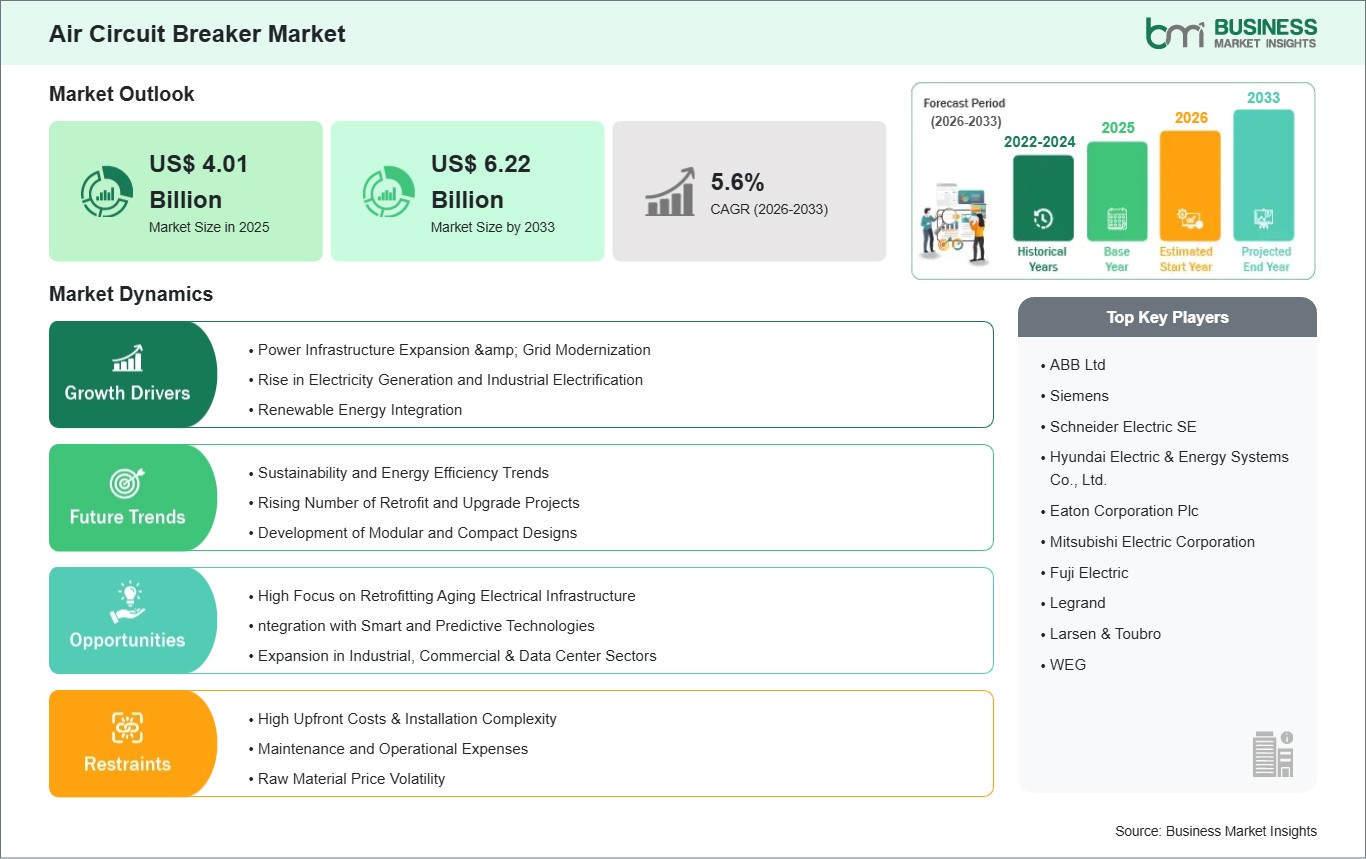
According to Business Market Insights, the global Air Circuit Breaker Market size is expected to reach US$ 6.22 Billion by 2033 from US$ 4.01 Billion in 2025. The market is estimated to record a CAGR of 5.64% from 2026 to 2033.
As grid operators balance aging infrastructure against the surging loads of electrification and decentralized power generation, air circuit breakers remain a highly favored, cost-effective defense against electrical faults. By relying on natural atmospheric air to extinguish electrical arcs, these systems provide critical protection against overcurrents and short circuits. Capital investment within the industry is heavily focusing on the integration of smart relay systems, bringing IoT-enabled remote monitoring, cybersecurity safeguards, and predictive maintenance capabilities to standard ACB arrays.
What Are Air Circuit Breakers?
Air Circuit Breakers (ACBs) are heavy-duty electrical switching devices designed to protect electrical circuits from damage caused by overcurrents, short circuits, and ground faults. Unlike vacuum or gas-insulated breakers that enclose their contacts in pressurized SF6 gas or vacuum chambers, ACBs utilize ambient atmospheric air as the primary arc-extinction medium. A typical ACB assembly houses primary and arcing contacts, arc chutes, and intelligent tripping mechanisms within a grounded enclosure.
When deployed in a low- or medium-voltage power distribution network, an ACB acts as the primary safety barrier. If a downstream electrical fault or sudden overload occurs, the breaker's relays detect the anomaly and signal the contacts to separate. As the contacts pull apart, a high-temperature electrical arc is formed. The ACB extinguishes this arc by magnetically blowing it upward into the arc chutes, where it is stretched, cooled, and split into smaller segments until it dissipates, safely interrupting the power flow and preventing catastrophic equipment damage.
Download Sample Report: https://www.businessmarketinsights.com/sample/BMIPUB00033279
Market Drivers
A primary driver accelerating the global Air Circuit Breaker Industry is the Power Infrastructure Expansion and Grid Modernization. Utilities and industrial conglomerates worldwide are investing heavily in strengthening electrical networks to meet rising global energy demands. To prevent grid failures and accommodate rising peak-load demands from urbanization, governments are aggressively funding major substation upgrades and replacing outdated protection devices, heavily driving the procurement of high-reliability air circuit breakers.
The High Focus on Retrofitting Aging Electrical Infrastructure serves as another core driver. Large portions of the electrical transmission and distribution (T&D) grids across North America and Europe were constructed decades ago and lack the sophisticated fault-interruption capabilities required by modern energy standards. Facility managers and grid operators are increasingly replacing legacy electromechanical breakers with advanced ACBs equipped with solid-state trip units, drastically minimizing "nuisance" trips and enhancing workplace safety.
Additionally, Surging Demand Across Data Centers and Industrial Automation acts as a major market catalyst. Rapid economic development and the explosion of cloud computing and AI require massive, uninterrupted power supplies. Data centers, alongside highly automated manufacturing plants, demand robust electrical distribution boards capable of handling high fault currents. ACBs provide the necessary heavy-duty switching and high-ampere protection required to keep these mission-critical facilities operational 24/7.
Market Segmentation
By Type
- Air Blast Circuit Breaker (Held the largest share of the market in 2025. The demand is increasing due to their high reliability, rapid arc extinction, low maintenance requirements, and enhanced safety in high-load scenarios)
- Plain Air Circuit Breaker (Maintains a steady market share, primarily supporting lower voltage applications and legacy industrial setups due to their cost-effectiveness and simple mechanical operation)
By Voltage
- Medium Voltage (Held the largest share of the market in 2025, driven by rapid industrialization, grid modernization, renewable energy integration, and expanding urban electrical infrastructure)
- Low Voltage (Experiencing robust growth due to widespread usage in commercial buildings, smart homes, data center distribution panels, and secondary light-industrial grids)
By Application
- Industrial (Held the largest share of the market in 2025, fueled by rising industrial automation, the need for reliable continuous-process power protection, and higher fault current handling requirements)
- Commercial (Secures a significant segment share due to smart building initiatives, massive commercial real estate developments, and expanding commercial healthcare infrastructure)
- Residential (Supported by the growing electrification of residential heating, decentralized solar power, and the integration of robust localized distribution boards)
Regional Insights
- Asia-Pacific holds the premier position globally and is also the fastest-growing region. This leadership is anchored by immense power infrastructure investments, rapid urbanization, and massive industrial expansions across China, India, and Southeast Asia that demand cost-effective protection solutions.
- North America captures a substantial portion of global revenues, supported by heavy utility investments aimed at modernizing aging grid infrastructure, improving grid resilience, and expanding large-scale data center footprints.
- Europe displays steady growth driven by aggressive industrial automation and the transition toward smart grids. Strict regulatory standards surrounding workplace electrical safety heavily favor the adoption of advanced, digitalized ACBs.
- Rest of the World accounts for a progressive market share, fueled by expanding energy infrastructure projects across the Middle East and growing commercial developments in Latin America.
Get More Insights: https://www.businessmarketinsights.com/buy/BMIPUB00033279
Top Players in the Industry
The competitive ecosystem of the air circuit breaker sector is characterized by heavy R&D investments, strategic regional expansions, and a deep focus on integrating digital diagnostic capabilities and IoT communications into traditional hardware.
- ABB Ltd.
- Siemens Energy AG
- Schneider Electric SE
- Eaton Corporation PLC
- Mitsubishi Electric Corporation
- Larsen & Toubro Limited
- Fuji Electric Co., Ltd.
- C&S Electric Limited
- Legrand SA
- Rockwell Automation, Inc.
Strategic Industry Challenges
Despite robust demand, the ACB market faces significant growth barriers regarding intense competition from alternative technologies. As urban centers and industrial plants prioritize space optimization, traditional air circuit breakers are frequently challenged by compact molded case circuit breakers (MCCBs) in low-voltage applications, and by vacuum circuit breakers (VCBs) or gas-insulated systems in medium-voltage sectors. Furthermore, the integration of advanced smart relays and solid-state sensors into ACBs increases the initial capital expenditure, which can temporarily deter adoption by smaller regional enterprises operating on tight capital budgets.
Future Market Outlook
The forward trajectory for the Air Circuit Breaker Market remains highly positive as the global push for secure electrification intensifies. The transition toward intelligent, software-defined electrical networks will drive the next generation of smart ACBs. Equipped with remote sensing, energy metering, and AI-driven predictive maintenance modules, future air circuit breakers will evolve from simple mechanical safety switches into proactive energy management hubs, ensuring their continued relevance as the backbone of global power distribution.
Frequently Asked Questions (FAQs)
What is the projected size of the global air circuit breaker market by 2033?
The market is projected to reach an estimated valuation of USD 6.22 Billion by 2033, growing from an established base of USD 4.01 Billion in 2025.
Which application segment dominates the market?
The industrial segment held the largest market share in 2025, driven by the absolute necessity for high-capacity fault protection and uninterrupted power supplies in automated manufacturing and processing facilities.
Which region is growing at the fastest rate?
The Asia-Pacific region is the fastest-growing market, heavily driven by rapid industrialization, massive urban infrastructure development, and expanding power generation networks in countries like China and India.
Browse More Reports:
About Us
Business Market Insights is a market research platform that provides subscription service for industry and company reports. Our research team has extensive professional expertise in domains such as Aerospace & Defense; Automotive & Transportation; Electronics & Semiconductor; Energy & Power; Healthcare; Manufacturing & Construction; Food & Beverages; Chemicals & Materials; and Technology, Media, & Telecommunications.
Contact Us
If you have any questions about this report or would like further information, please contact us:
Contact person: Ankit Mathur
Email: sales@businessmarketinsights.com
Phone: +16467917070